TMF Starting Grant awards 2025
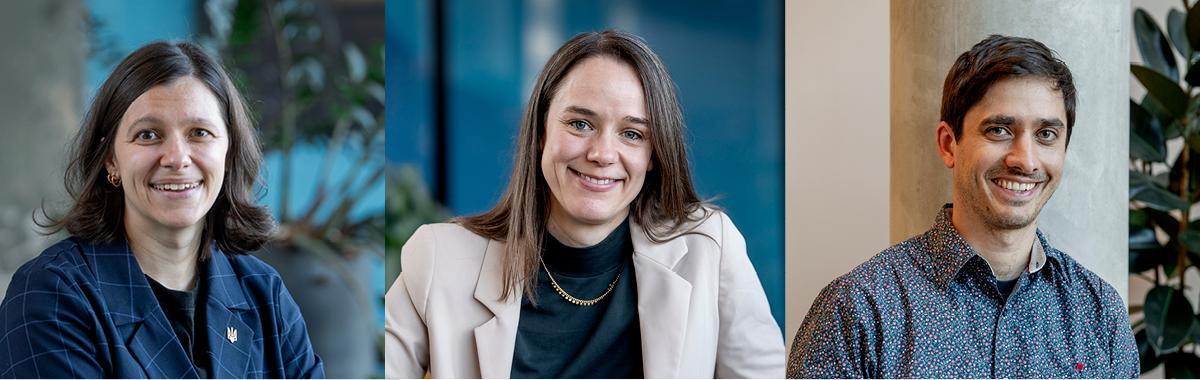
Valeriia Kalienkova, Rachael Morgan and Sebastian Wolf have been awarded the Trond Mohn Research Foundation Starting Grant 2025, receiving NOK 10 million each. The grant enables the realisation of three groundbreaking projects that could transform our understanding of the brain, life in the ocean, and Earth’s landscapes.
“It is a great pleasure to congratulate Valeriia Kalienkova, Rachael Morgan and Sebastian Wolf on receiving the Trond Mohn Research Foundation Starting Grant for 2025. We look forward to following these outstanding researchers and their exciting projects in biomedicine, biology and geoscience,” says UiB Rector Margareth Hagen.
Mapping the brain’s hidden signalling pathways
Valeriia Kalienkova studies how acid-sensing ion channels (ASICs) in the brain influence pain, memory and learning. These tiny “gates” respond when the environment around nerve cells becomes more acidic – for example, during pain or stroke – and are linked to serious diseases such as stroke and cancer. Yet we still know little about how they function in the brain.
In the PhysiolASIC project, Kalienkova uses advanced methods to study ASICs in their natural environment. The goal is to develop new molecules that can affect these ion channels and test them directly on brain tissue. This research could provide new insights into the brain’s signalling networks and pave the way for future medicines against pain and brain disorders.
How does climate influence Earth’s inner forces?
Sebastian Wolf now has the opportunity to realise his ICICLE project. Together with his research team, he will explore how mountains and landscapes are shaped when Earth’s internal forces interact with climate. The researchers will use computer models to understand how ice ages and erosion have altered mountain ranges over millions of years. The project will deliver crucial new knowledge about why landscapes look the way they do and how natural forces create both spectacular mountains and hazards such as landslides.
By developing the first models that combine Earth’s internal forces with climate-driven glacial erosion, ICICLE will address one of geoscience’s big questions – and provide insights that help us understand future landscapes and climate risks.
What happens to fish senses as the ocean changes?
Climate change is causing warmer oceans and, in many places, lower oxygen levels. Both factors affect fish in numerous ways, but we know little about what happens to their vision and ability to detect and respond to threats.
Rachael Morgan will, for the first time, investigate how heat and oxygen depletion cause vision to become slower, colourless and blurry, making it harder to perceive predator attacks. Morgan uses advanced experiments in an innovative Virtual Reality setup that recreates lifelike scenarios where fish perceive simulated predator attacks as real. Do fish use more energy when frightened? Do they eat less? How are growth and survival affected? The results will provide new knowledge about how climate change influences fish behaviour and what this means for fish populations.
Award ceremony at the University Aula
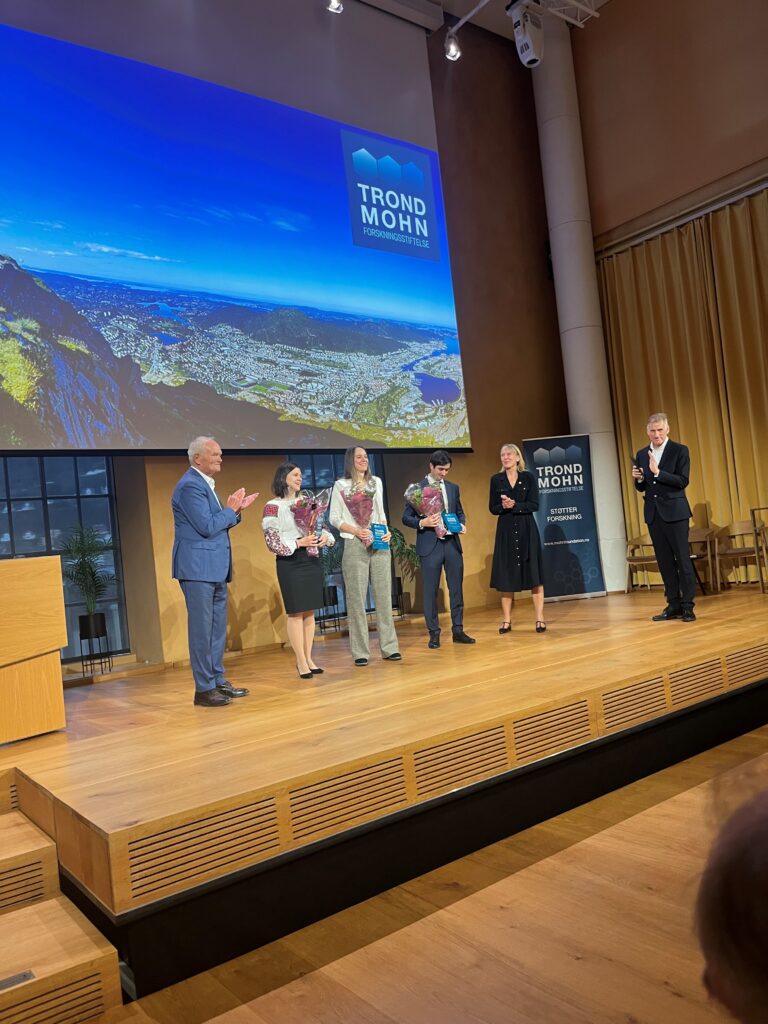
The prestigious TMF Starting Grant was awarded during the foundation’s annual celebration in UiB’s University Aula on Friday, 5 December.
“The candidates and projects have undergone a thorough scientific evaluation, and we have high expectations for these outstanding young researchers,” says Nicholas Nunn, CEO of the Trond Mohn Research Foundation.
Facts about the TMF Starting Grant-programme
- A recruitment program open to all research fields at the University of Bergen.
- Candidates are given the opportunity to establish their own research group and realise their dream project.
- Since 2008, the program has helped recruit 53 outstanding young researchers to UiB, and the foundation has provided a total of NOK 455 million in support for this flagship program.
- Winners receive up to NOK 10 million in funding from the foundation – and UiB contributes an equivalent amount.
- Competition for the TMF Starting Grant is intense, and scientific quality is the main criterion. Candidates are nominated by UiB, evaluated by independent international experts, and interviewed by the foundation’s advisory committee.
- At the end of the project period, UiB will announce an academic position within the candidate’s field, which the candidate can apply for.